What is so called Chat Control?
From Fight Chat Control website:
The "Chat Control" proposal would legalise scanning of all private digital communications, including encrypted messages and photos. This threatens fundamental privacy rights and digital security for all EU citizens.
The EU (still) wants to scan your private messages and photos
There have been several attempts to push so-called "Chat Control" at the EU level. Sanity won out—until now. The very fact that this is even on the table reveals just how many imbeciles have found their way into the European Parliament and beyond.
The trick
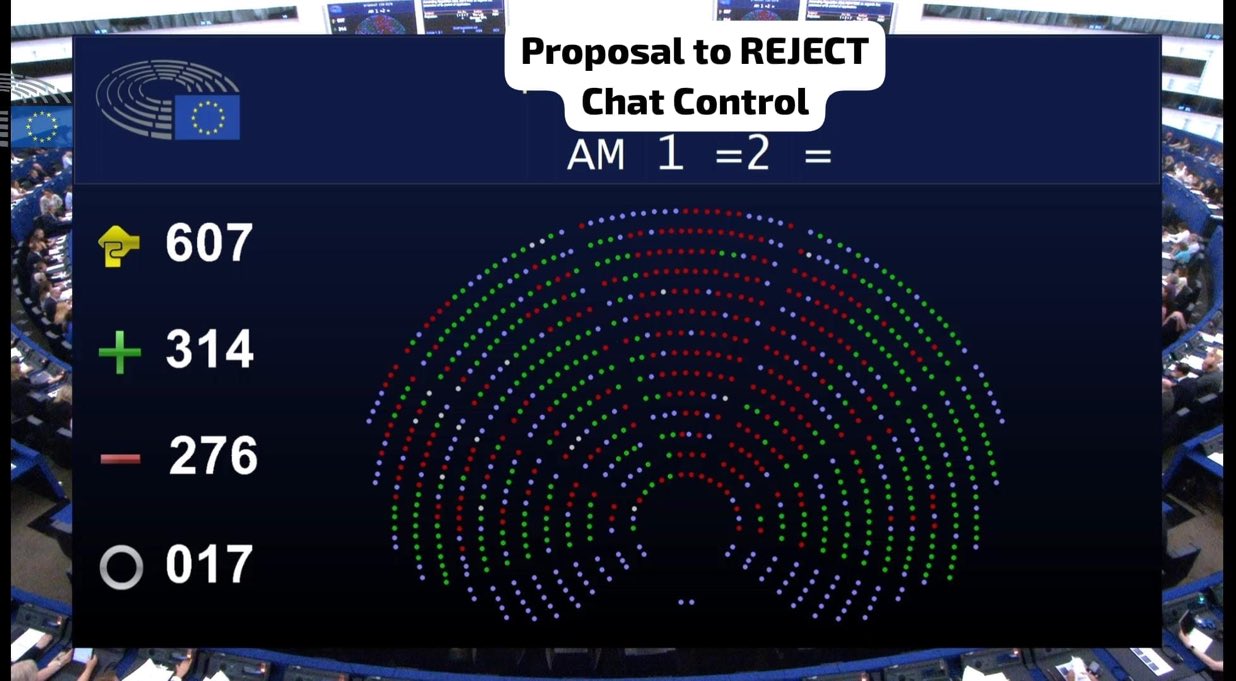
Because Chat Control was a Council proposal, killing it required 360 votes—an absolute majority of MEPs. The vote was strategically scheduled for the last day before summer recess, when half the chamber had already checked out. The opposition mustered 314 votes—impressive, but not enough. The threshold stood, and the proposal survived by procedural default.
The aftermath
From EFF:
The good news is that the most controversial part, the forced requirement to scan encrypted messages, is out. The bad news is there’s more to it than that.
Thanks to the tireless efforts of digital rights groups, including European Digital Rights (EDRi), we won a significant improvement: the Council agreed on its position, which removed the requirement that forces providers to scan messages on their services. It also comes with strong language to protect encryption, which is good news for users.
But here comes the rub: first, the Council’s position allows for “voluntary” detection, where tech platforms can scan personal messages that aren’t end-to-end encrypted. Unlike in the U.S., where there is no comprehensive federal privacy law, voluntary scanning is not technically legal in the EU, though it’s been possible through a derogation set to expire in 2026. It is unclear how this will play out over time, though we are concerned that this approach to voluntary scanning will lead to private mass-scanning of non-encrypted services and might limit the sorts of secure communication and storage services big providers offer.
Conclusion
For years now, the EU has been heading in the wrong direction—economically and socially. At the political level, it's a complete mess, and foreign relations, with the United States and Russia, are wobbly, to say the least. Incompetent leaders are doing their best to drive everything into the ground at all costs. But for this to succeed—and to prevent citizens from rising up—full control must be implemented. That's why you hear about "age verification," "online ID," and other forms of surveillance. That's why regular people are being arrested in the UK and Germany over messages on X or other platforms.
German Chancellor Friedrich Merz is pushing to end online anonymity by mandating real names on social media and proposing a ban on platform access for users under 16. Speaking in February 2026, he argued that citizens should debate using their real identities, just as politicians do, citing concerns over AI-driven influence campaigns and the need to protect democracy. Existing German law already allows prison sentences of up to five years for defamation against politicians.
This is no longer about free speech and democracy—it's about total control of the population. Things are going wrong in the EU, and the unelected so-called leaders know it. And they will try to preserve their positions of power at any cost.
Bonus: Joke of the day