It has been a hard time for Germany, and it is getting darker. Long years of costly green policies and suffocating bureaucracy, capped by the cutoff of Nord Stream, have left the country in an ultra-vulnerable position.
Its auto industry—once a model to follow—is now shutting down. The EU-level push toward electric vehicles had an unintended effect: it opened the door to cheap and reliable Chinese competitors.
Porsche — the warm-up
Porsche, part of VW Group, is not feeling that well. Recent financial turmoil stems from a massive 98% drop in operating profit in 2025 (falling from €5.3 billion to €90 million) and a $1.1 billion quarterly loss in Q3 2025. These figures were driven by €2.7 billion in write-downs related to a strategic rollback of its electric vehicle (EV) expansion, rather than operational insolvency. To address liquidity and focus on core business, Porsche recently sold its stakes in Bugatti Rimac for approximately €1 billion.
Volkswagen — the big news
But the biggest news comes from Volkswagen itself.
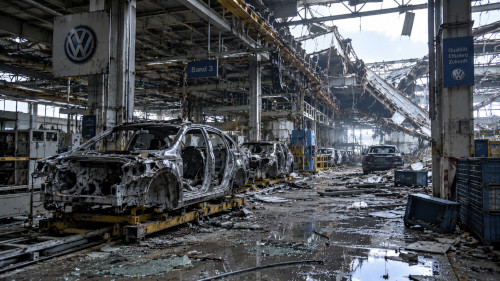
Volkswagen is preparing for one of the most significant restructurings in its history, with internal plans reportedly targeting four German factories for phased production shutdowns between 2031 and 2034. The decision, detailed in a confidential supervisory board document, reflects mounting pressure on Europe's largest automaker to cut costs and secure its long-term competitiveness.
According to reports from German business outlet WirtschaftsWoche, the Volkswagen management board has unanimously approved a plan to end vehicle production at four locations:
| Plant | Planned Production End | Workforce |
|---|---|---|
| Emden | 2031 | ~7,700 |
| Zwickau | 2031 | ~8,000 |
| Hannover | 2032 | ~13,000 |
| Neckarsulm (Audi) | 2034 | ~15,500 |
As reported in n-tv.de, finance.yahoo.com and carscoops.com.
Volkswagen estimates the costs for its planned reduction of around 60,000 jobs and the possible closure of four German car factories at a total of around 16 billion euros. This is evident from the supervisory board's decision last Thursday, as well as other internal documents available to Der Spiegel.
Ten billion euros alone are expected to be spent on job cuts by 2030. The money will be used, among other things, for partial retirement, severance payments and social plans. Approximately half of the jobs are to be eliminated in Germany.
The financial and human cost
According to insider estimates reported by Reuters, Volkswagen has earmarked approximately €16 billion for the closures and associated job cuts. This includes €1 billion each for Emden and Zwickau, €2 billion each for Hannover and Neckarsulm, plus an additional €10 billion for reducing up to 60,000 positions worldwide.
The escape
But not everything is doom and gloom. Volkswagen has reached a preliminary agreement to sell its Osnabrück factory to Israeli investment firm Aurelius Capital and the State of Lower Saxony. The plant, which currently produces the T-Roc Cabriolet, is scheduled to end vehicle production in summer 2027. So no more cars—but more military hardware for Israel.
Not only Volkswagen
Mercedes-Benz seems to feel the heat as well.
Mercedes-Benz is reportedly putting increasing pressure on its German production operations as the automaker looks for ways to reduce costs and improve factory efficiency. According to a report from German business weekly WirtschaftsWoche, company management has allegedly warned employee representatives that a German factory could eventually become unnecessary if labor costs cannot be significantly reduced.
There has been no official decision to close a German factory, and it remains unclear which location could potentially be affected. Neither Mercedes-Benz management nor its supervisory board has reportedly made a final decision.
Well, at least not yet.
Steel production next in line
Not only the automotive industry gets a hit, but also the steel industry: ArcelorMittal has confirmed plans to end steel production at its Duisburg-Ruhrort site starting October 2027. The steelmaking plant, continuous casting facility, and billet rolling mill will be shut down, affecting approximately 550 of the roughly 800 jobs at the site.
ArcelorMittal examined converting Duisburg to an electric arc furnace (EAF) route—the technology associated with "green steel"—but concluded it was not economically viable.
IG Metall had been demanding investment in an EAF for the Duisburg site since at least mid-2025. The union explicitly cited high electricity prices as a barrier to the investment decision. ArcelorMittal had also withdrawn from green steel transformation projects at its Bremen and Eisenhüttenstadt plants in June 2025, citing economic conditions.
An IHK representative described the closure as a "clear alarm signal for Germany as an industrial location," noting that energy-intensive industries can no longer compete internationally. Not without the cheap Russian energy that now it's gone.
How about green energy?
Troubles also here. Enerparc AG did file for insolvency. The most striking detail is the timing—it happened just six months after the company announced a major financing package.
The filing only affects the parent company Enerparc AG, not automatically its project companies or subsidiaries. The company employs roughly 700 people across the group, with about 380 directly affected at the parent level. Employee salaries are secured for three months through insolvency benefits.
The company is based in Hamburg's HafenCity and, with around 5.5 gigawatts of installed capacity and more than 500 solar parks, sees itself as one of the largest independent solar park owners in Europe.
Neither Enerparc nor the insolvency administrator has publicly stated the exact causes. However, financial data and market conditions point to several factors:
1. Negative operating cash flow at the parent level
Despite reporting €436 million revenue and €54 million net profit in 2024, the parent company Enerparc AG had a negative operating cash flow of €80.9 million. This was largely due to the parent providing short-term pre-financing to project companies—a typical developer model where money flows out first and returns only after projects are completed and sold or refinanced.
2. Grid connection bottlenecks
Enerparc has 5.5 GW of installed capacity, but only 3.8 GW is actually connected to the grid. The remaining 1.7 GW of built projects are stuck waiting for grid connections. This means they are already incurring depreciation and interest costs without generating any revenue.
3. Market pressure across the solar sector
The broader German solar industry is under significant strain. Falling auction prices, rising project costs, and regulatory uncertainty are squeezing developers. Several other German solar companies have also entered insolvency proceedings in 2026, including module manufacturer Soluxtec and developer SoWiTec.
Dark times ahead for the country once known as the proud factory of Europe.
And all the globalists are wondering how the AfD can rise so much.