90 billion prize
Not that long ago, in April this year, Ursula von der Leyen was proudly announcing that "Today is a good day for Europe" and a so-called loan with the staggering amount of 90 billion euros was awarded to Ukraine. This was supposed to cover Ukraine's military and financial needs for 2026 and 2027. Well, that math is now out of the window.
More money is needed
Fast forward to November, and the EU plans a new "loan" of €45 bn to Ukraine.
The European Union is "as committed as ever to support Ukraine in war and in peace", Ursula von der Leyen said as she unveiled a €45 billion support loan to help the country address its growing wartime budget deficit.
Ukrainian President Volodymyr Zelenskyy publicly thanked her, saying "strong support for Ukraine is the best signal to Russia that this war must end".
EU budget talks collapse
However, this didn't go as expected, with growing opposition in the EU. Despite Merz's threats to block a budget deal unless all member states agree to enter financial slavery, the budget talks went nowhere. The right questions were raised:
Bulgaria, Hungary, Slovakia, and the Czech Republic have resisted participating in the new loan. Two diplomats told Politico that Bratislava was taking the hardest line. Slovak Prime Minister Robert Fico has accused Merz of “blackmail,” while Bulgarian President Rumen Radev said his country was prepared to back civilian aid only.
Czech Prime Minister Andrej Babiš: Since the beginning of the conflict, Ukraine has received €520 billion, directly or indirectly, and Mr. Zelensky received €90 billion, supposedly for 2026 and 2027. Now he needs another €70 billion. So I want to ask: What is the objective? Are we going to pay Ukraine €135 billion every year? And until when? For how many years? Ten, twenty, thirty? What kind of strategy is that?
Economic situation is dire overall
Dutch Prime Minister Rob Jetten backed Berlin's demand that every country contribute. However, the economic situation in Europe is getting worse by the day, with the prime example of Germany going through rough times due to high energy prices, deindustrialization, and enormous financial support for refugees (from Ukraine or elsewhere).
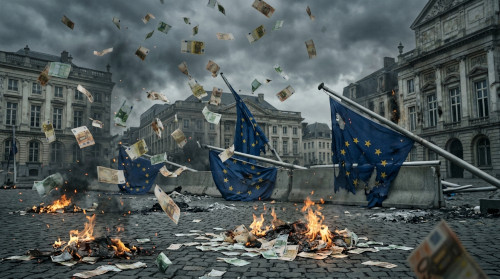
The Eastern and Central side is not feeling well, and Bulgaria is having a hard time keeping its budget under control (especially after it committed suicide by adhering to the eurozone). Belgium's austerity plans brought more than 50,000 people onto the streets of Brussels.
France and Spain have a fair share of social movements in the streets, since poverty makes you raise your voice stronger. So not that many happy times for the EU anymore. Everything seems to crumble in an accelerated way.
Repaying the loans
The whole premise of these so-called loans is that they will be paid when Russia loses the war. This is utterly nonsense, and the countries backing up this huge amount of money will be forced to pass the whole burden on their budgets, and in the end, increase taxes and cut expenses to social security, health, or educational systems. Not the military, which will actually get extra money, but you don't need smart people anyway in the era of AI, right?
Elites of the EU have different priorities than the welfare of the Europeans. But the show must go on. Next time Zelenskyy should stop joking around and be more serious: a 1 trillion loan each year is something that makes more sense.
*Hungary, Slovakia, and the Czech Republic were smart enough to avoid this financial suicide in the first round.