From Reunification to Expansion: The 1990s and the Ukraine Conflict
How the post–Cold War order, German reunification, and NATO’s eastward enlargement shaped today’s confrontation.
The 1990s brought major changes to Europe's political configuration, through the fall of the Berlin Wall and the dissolution of the USSR. This moment can be seen as an essential moment with major implications up to the present day, including the underlying motives of the war in Ukraine.
German Reunification
The official reunification of Germany took place on 3 October 1990, when the German Democratic Republic (GDR), or East Germany, merged with the Federal Republic of Germany (FRG – West Germany). Several events took place as precursors to this unification.
- Malta, December 1989 — Bush and Gorbachev
In early December 1989, George H. W. Bush and Mikhail Gorbachev met in Malta. The collapse of communist regimes in Eastern Europe was rapidly changing the geopolitical balance. Bush conveyed that the US did not intend to take unilateral advantage of the USSR's weakening. At that moment, however, there was not yet a concrete promise regarding NATO expansion. - 31 January 1990 — Genscher's speech
West German Foreign Minister Hans-Dietrich Genscher explicitly introduced the issue of the military status of the former East Germany and the need to take Soviet security interests into account. The idea of limiting the extension of NATO military jurisdiction became part of the negotiations. - 9 February 1990 — Baker and Gorbachev
US Secretary of State James Baker met with Mikhail Gorbachev in Moscow. The American memorandum records the formula "not one inch eastward" and specifies that, if a reunified Germany remained in NATO, there would be no extension of NATO jurisdiction for NATO forces eastward. Baker also raised the alternative of a neutral Germany versus a Germany in NATO with such assurances. - 10 February 1990 — Baker writes to Kohl
Baker conveyed to Helmut Kohl the outcome of the meeting with Gorbachev and described Soviet concerns. The document shows that the issue of assurances regarding eastward expansion was part of the diplomatic discussion on reunification. - 10 February 1990 — Kohl and Gorbachev
In the conversation with Gorbachev, Kohl said: "We believe that NATO should not expand its scope." The documents show that the military status of reunified Germany was negotiated in close connection with Soviet concerns regarding European security. - 13 February 1990 — the 2+4 format
In Ottawa, the framework for the 2+4 negotiations was established: the two Germanies plus the USA, the USSR, Great Britain, and France. The external aspects of German reunification were being negotiated, including military and security status. - May–June 1990 — negotiations continue
Baker, Bush, and the other Western leaders continued negotiations with Gorbachev. Gradually, the discussion shifted from the question of whether Germany would be in NATO to the concrete issue of the military status of the former East Germany. - July 1990 — Kohl and Gorbachev
At the meeting in the Caucasus, Gorbachev accepted that reunified Germany would have the freedom to choose its alliances, including NATO. In exchange, special military restrictions for the territory of the former GDR and the withdrawal of Soviet troops were negotiated. - 12 September 1990 — the 2+4 Treaty
The Treaty on the Final Settlement with Respect to Germany legally enshrined the status of reunified Germany. Article 5 establishes restrictions on forces and nuclear weapons on the territory of the former GDR. However, the treaty does not contain a general prohibition on NATO's future expansion into Eastern Europe. - 3 October 1990 — reunification
Germany reunifies. The USSR had accepted a reunified Germany that remained in NATO, within a set of arrangements regarding the military status of the former GDR and the withdrawal of Soviet troops.
Despite the signing of an official treaty, it is clear from all these discussions that an understanding between the former USSR and NATO/the United States took place, and German unification was accepted in exchange for the statement that NATO would not expand toward Russia in the future.
NATO Expansion
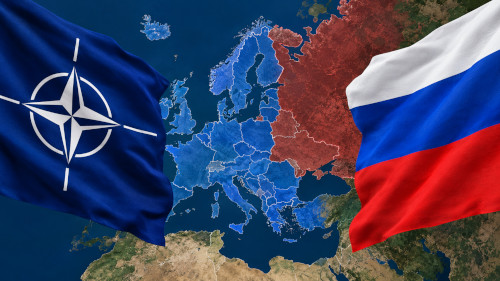
NATO expansion after 1990, under US leadership, was a process through which the states of Central and Eastern Europe and the former Soviet republics were gradually integrated into the alliance's military and political structure, under the pretext of the "open door." This process fundamentally changed Europe's security configuration and was perceived by Russia as continuous pressure on its strategic space.
Chronology and stages of NATO expansion
After the Cold War, NATO went through five main waves of expansion, from 16 to 32 member states.
- The first wave — 1999. In 1999, the Czech Republic, Hungary, and Poland joined. These were the first former Warsaw Pact member states to enter NATO. Russia vehemently opposed this, but could not prevent the process.
- The second wave — 2004. In 2004, Bulgaria, Estonia, Latvia, Lithuania, Romania, Slovakia, and Slovenia joined. This was the largest expansion in NATO's history. For the first time, former Soviet republics were included, namely the Baltic states.
- The third wave — 2009. In 2009, Albania and Croatia joined. These were states from the Western Balkans.
- The fourth wave — 2017. In 2017, Montenegro joined, which represented a continuation of penetration into the Balkans.
- The fifth wave — 2020. In 2020, North Macedonia joined, after the resolution of the name dispute.
The most recent accessions — 2023 and 2024. In 2023, Finland joined, and in 2024, Sweden. Both renounced their policy of military non-alignment as a result of the Russian invasion of Ukraine. Finland joined very quickly.
Russia perceived NATO expansion from the beginning as a fundamental threat. NATO expansion "advanced over 1,000 kilometers, reaching directly to Russia's border." Russia long supported transforming the Organization for Security and Cooperation in Europe into a pan-European system to manage European security, but this was rejected by NATO and by most of the states of Central and Eastern Europe.
Russia was also forced to accept in 1997 the NATO–Russia Founding Act, a document that practically "eliminated the Russian factor" from the equation of NATO's first wave of expansion.
In 2008, the Bucharest summit declared that Ukraine and Georgia "will become NATO members," without, however, offering a timetable, which Russia considered a crossed red line. Putin later repeatedly accused the West of having violated the promise from the 1990s to "not expand one inch eastward."
For comparison, I recommend reading about the Cuban Missile Crisis of 1962, a moment when the world was closest to nuclear war. For 13 days, the United States and the Soviet Union confronted each other directly, after Washington discovered that Moscow was installing nuclear missiles on the Caribbean island, only 90 miles from the Florida coast.
Now reflect this arrangement in the Russia–United States relationship via Ukraine.
Actions from the past have consequences in the present. But it seems that some people never learn.
Documents and complete links
- National Security Archive — Baker–Gorbachev, 9 February 1990
https://nsarchive.gwu.edu/document/16116-document-05-memorandum-conversation-between - National Security Archive — Soviet version of Baker–Gorbachev
https://nsarchive.gwu.edu/document/16117-document-06-record-conversation-between - National Security Archive — Baker to Kohl, 10 February 1990
https://nsarchive.gwu.edu/document/16119-document-08-letter-james-baker-helmut-kohl - OCR — Baker to Kohl
https://nsarchive.gwu.edu/media/16119/ocr - National Security Archive — Kohl–Gorbachev, 10 February 1990
https://nsarchive.gwu.edu/document/16120-document-09-memorandum-conversation-between - OCR — Kohl–Gorbachev
https://nsarchive.gwu.edu/media/16120/ocr - National Security Archive — Gates–Kryuchkov, 9 February 1990
https://nsarchive.gwu.edu/document/16118-document-07-memorandum-conversation-between - National Security Archive — the "NATO Expansion: What Gorbachev Heard" file
https://nsarchive.gwu.edu/briefing-book/russia-programs/2017-12-12/nato-expansion-what-gorbachev-heard-western-leaders-early - Federal Foreign Office of Germany — the 2+4 Treaty, 12 September 1990
https://www.auswaertiges-amt.de/en/aussenpolitik/themen/uebersicht-248550 - Federal Foreign Office of Germany — German-language page
https://www.auswaertiges-amt.de/de/aussenpolitik/regelbasierte-internationale-ordnung/voelkerrecht-internationales-recht/240218-240218
Note on sources: the National Security Archive documents come from declassified materials of the US Department of State and from documents later published in German/Soviet documentary editions. For the 2+4 Treaty, the official page of the Federal Foreign Office of Germany is indicated, which also provides the PDF of the full text.